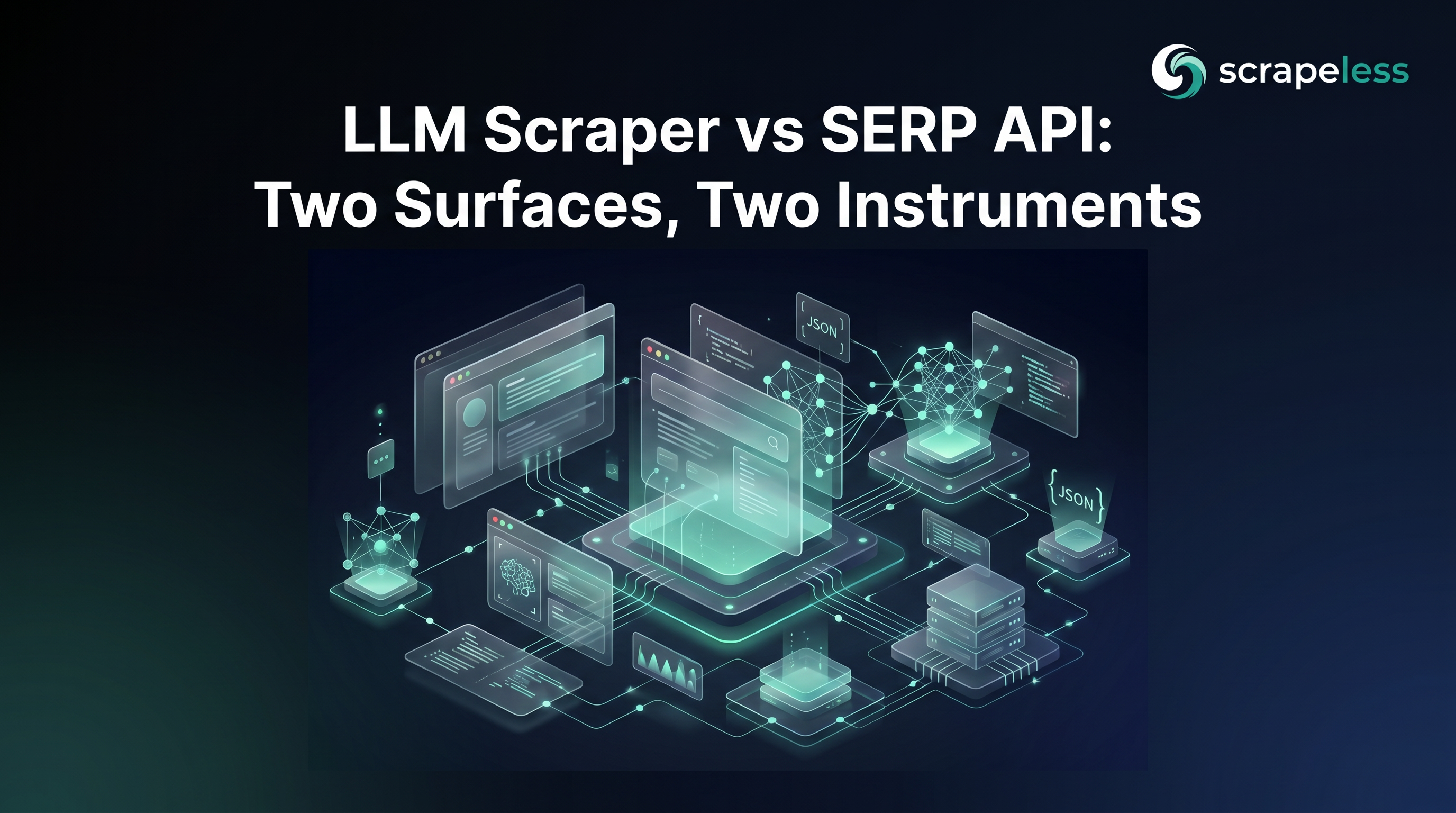
LLM Scraper vs SERP API: Two Surfaces, Two Instruments

Scraping and Proxy Management Expert
TL;DR:
- A SERP API and an LLM scraper measure two different surfaces. One returns a search results page as ranked links; the other returns an AI platform's synthesized answer with its citations. GEO programs end up needing both.
- The unit of data differs. SERP output is positional — who ranks where for a query. LLM-scraper output is referential — what the answer says and which sources it credits.
- The metrics differ with it. Rank tracking reads positions over time; AI-answer tracking reads share of citation — how often a domain appears among an answer's sources.
- Google itself now spans both. The AI Overview block and AI Mode tab sit on top of classic results, with dedicated actors (
scraper.overview,scraper.aimode) separate from the organic SERP actor. - The two layers interlock. AI answers tend to cite pages that earn search visibility, so the citation series and the rank series explain each other — which is the practical argument for running both.
- Free to start. New Scrapeless accounts include free trial credits — sign up at app.scrapeless.com.
Introduction: two instruments for two surfaces
Search visibility used to be one number: where you rank. Buyers now meet brands on a second surface — the synthesized answer an AI assistant gives, with a short list of cited sources. The two surfaces move independently, and they are measured by different instruments.
Teams shopping for tooling run into the comparison constantly: a SERP API and an LLM scraper both "scrape search," both return JSON, and both feed dashboards. They answer different questions. This guide lays out the split — what each captures, what each costs to run, and which one a given monitoring program needs — using the Scrapeless implementations of both as the reference shapes.
What each one is
A SERP API captures a search engine results page as structured data. The Scrapeless version is Deep SerpApi: one POST to the scraper.google.search actor returns the parsed page — organic_results with positions, titles, and URLs — across 20+ Google scenarios (Search, Maps, News, Scholar, Flights, Trends, Hotels, Jobs, Lens), typically in one to two seconds.
An LLM scraper captures an AI platform's answer. The Scrapeless LLM actors (scraper.chatgpt, scraper.grok, scraper.gemini, scraper.perplexity, scraper.copilot) take a prompt, run it against the live platform over country-pinned residential egress, and return the answer text plus the citations as discrete fields — source titles, URLs, and attributions, under one shared { status, task_id, task_result } envelope. The what-is-an-LLM-scraper primer ranks the tools in that category.
Side by side
| Dimension | SERP API | LLM scraper |
|---|---|---|
| Target surface | Search results page | AI platform's answer |
| Input | Query (+ vertical, locale params) | Prompt (+ country, platform-specific fields) |
| Output shape | Ranked lists: organic_results, ads, related searches |
Answer text + citation arrays |
| Unit of analysis | Position per query | Citation per prompt |
| Core metric | Rank over time | Share of citation over time |
| Determinism | Same query, broadly stable page | Same prompt, answer varies run to run — the series is the signal |
| Locale sensitivity | Per-country SERPs | Per-country answers and citations |
| Pricing shape | Per-1,000 queries ($1.05/1K on Deep SerpApi; 2,000 free calls) | Usage-based with free trial credits |
| Staleness model | Page changes when the index updates | Answer can change between any two runs |
What GEO actually needs
Generative engine optimization gets framed as a replacement for SEO measurement. In practice it is an addition. The questions a visibility program has to answer split cleanly:
- "Where do my pages rank for these queries?" — SERP API territory. Positions are the input to everything else; they also remain the thing classic search traffic depends on.
- "What do the AI assistants tell buyers about my category, and whom do they cite?" — LLM scraper territory. No ranked list exists here; the citation array is the whole measurable surface.
- "Why did my AI-answer presence change?" — usually both. AI answers lean on web sources that carry search visibility, so a citation gained or lost often traces back to a page rising or falling in the index. Reading the citation series against the rank series is what turns a mystery into a diagnosis.
Get your API key on the free plan: app.scrapeless.com
Google's middle layer
Google complicates the boundary by shipping both surfaces on one page. A modern Google SERP can carry an AI Overview block above the organic results, and the AI Mode tab is a full answer-engine experience — synthesized response, citations, follow-ups.
Tooling-wise these sit with the LLM actors, not the SERP parser: scraper.overview captures the AI Overview block with its cited sources, and scraper.aimode captures the AI Mode tab. The AI Overview guide covers that pair end to end. A complete Google picture is therefore three captures: the organic SERP, the AI Overview, and AI Mode — same endpoint family, three actors.
Decision guide
- Pick a SERP API when the program is rank tracking, keyword research, or anything whose unit is a position on a results page. The output is stable, cheap per query, and pairs naturally with existing SEO dashboards — pricing is a flat per-1,000.
- Pick an LLM scraper when the question is about answers: brand mentions in AI responses, share of citation, multi-platform answer comparison. Budget for scheduled runs, because single captures of a non-deterministic surface prove little.
- Run both when the program is GEO in any serious sense. The rank series explains the citation series; either one alone leaves the "why" unanswered.
Conclusion: instruments, not rivals
A SERP API measures the ordered web; an LLM scraper measures the synthesized one. The first tells you where pages stand, the second tells you what the assistants say and whom they credit — and the citation series usually makes sense only next to the rank series. Treat them as two instruments on the same dashboard, pick per question, and let one key drive both.
Ready to Measure Both Surfaces?
Join our community to claim a free plan and connect with developers building search and AI-answer pipelines: Discord · Telegram.
Sign up at app.scrapeless.com for free trial credits, and point the SERP and LLM actors at the queries and prompts your visibility program tracks.
FAQ
Q: Is an LLM scraper just a SERP API pointed at a chatbot?
The request shape rhymes, but the data model differs at the root: a SERP has an order, an answer has none. SERP rows are comparable by position; answer captures are comparable only as a time series of text and citations.
Q: Can a SERP API capture AI Overviews?
The AI Overview is a different block with different fields, which is why it has a dedicated actor (scraper.overview) rather than living inside the organic-results parser.
Q: Why are LLM-scraper results different every run?
Generative answers are non-deterministic and locale-sensitive. That volatility is the phenomenon a GEO program measures — capture on a schedule, pin the country, and read the trend.
Q: Which is cheaper to run?
They bill differently: Deep SerpApi is a flat $1.05 per 1,000 queries with 2,000 free calls to start; the LLM actors are usage-based with free trial credits. A rank tracker's cost scales with keywords; an answer tracker's with prompts × platforms × markets.
Q: Do both run under one account?
Yes — one Scrapeless API key and one x-api-token header cover the SERP actor and the LLM actors alike.
At Scrapeless, we only access publicly available data while strictly complying with applicable laws, regulations, and website privacy policies. The content in this blog is for demonstration purposes only and does not involve any illegal or infringing activities. We make no guarantees and disclaim all liability for the use of information from this blog or third-party links. Before engaging in any scraping activities, consult your legal advisor and review the target website's terms of service or obtain the necessary permissions.